
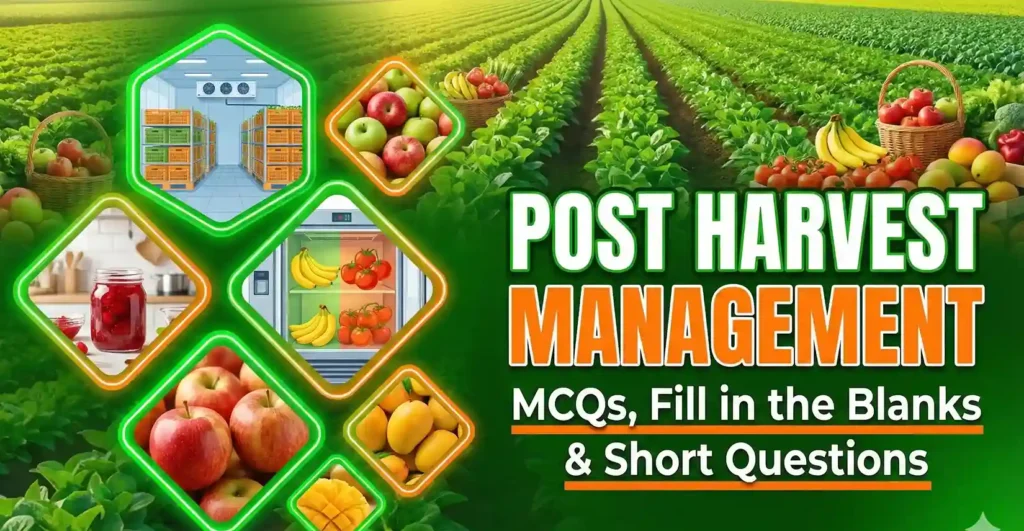
Post harvest management is one of the most important units in agriculture and horticulture courses, and questions from this topic frequently appear in university exams and competitive tests. Instead of long theory, most exams focus on MCQs, fill in the blanks, and short answer questions.
This post provides a comprehensive practice set of Post-Harvest Management MCQs and Questions and Answers. prepared strictly according to standard agricultural notes. Topics such as fruit ripening, respiration, harvesting, field handling, storage, post-harvest losses, value addition, and jelly preparation are covered in an exam-oriented manner.
If you are preparing for B.Sc. Agriculture, ICAR, or state-level exams, this practice-based post will help you revise quickly and score better.
Section A: Post harvest management MCQs
Ripening of Fruits
Q1. Ripening is best defined as:
A. Increase in fruit size
B. Initial growth stage
C. Terminal period of maturity improving quality
D. Senescence stage
✅ Ans: C
Q2. The hormone mainly responsible for fruit ripening is:
A. Auxin
B. Gibberellin
C. Cytokinin
D. Ethylene
✅ Ans: D
Q3. Ethylene is classified as:
A. Solid hormone
B. Liquid hormone
C. Gaseous hormone
D. Synthetic hormone
✅ Ans: C
Q4. Sweetness in ripe fruits increases due to the conversion of:
A. Protein to sugar
B. Cellulose to starch
C. Starch to sugar
D. Acid to sugar
✅ Ans: C
Changes During Ripening
Q5. Colour change during ripening occurs mainly due to:
A. Chlorophyll synthesis
B. Chlorophyll breakdown
C. Protein synthesis
D. Increase in respiration
✅ Ans: B
Q6. Softening of fruits during ripening is caused by the breakdown of:
A. Starch
B. Cellulose only
C. Pectic substances
D. Sugars
✅ Ans: C
Q7. Aroma development during ripening is due to the formation of:
A. Minerals
B. Volatile compounds
C. Organic acids
D. Proteins
✅ Ans: B
Q8. During ripening, acidity generally:
A. Increases
B. Decreases
C. Remains constant
D. Becomes zero
✅ Ans: B
Q9. Increase in respiration rate during ripening is known as:
A. Senescence
B. Dormancy
C. Climacteric rise
D. Transpiration
✅ Ans: C
Respiration
Q10. Respiration in harvested produce results in the release of:
A. Oxygen
B. Nitrogen
C. Carbon dioxide and heat
D. Ethylene only
✅ Ans: C
Q11. The shelf life of fruits is inversely proportional to:
A. Sugar content
B. Respiration rate
C. Water content
D. Colour intensity
✅ Ans: B
Q12. Which factor increases respiration rate most rapidly?
A. Low temperature
B. High CO₂
C. Mechanical injury
D. Low oxygen
✅ Ans: C
Q13. Which condition suppresses respiration in storage?
A. High oxygen
B. High temperature
C. High CO₂ concentration
D. Low humidity
✅ Ans: C
Harvesting
Q14. Harvesting should be done at:
A. Ripening stage
B. Immature stage
C. Proper maturity stage
D. Senescence stage
✅ Ans: C
Q15. Selective harvesting is practised when fruits:
A. Ripen uniformly
B. Do not ripen simultaneously
C. Are root crops
D. Are for processing only
✅ Ans: B
Q16. The best time of day for harvesting fruits is:
A. Noon
B. Afternoon
C. Early morning or late evening
D. Midnight
✅ Ans: C
Q17. Mechanical harvesting is generally unsuitable for:
A. Cereals
B. Pulses
C. Soft fruits
D. Oilseeds
✅ Ans: C
Field Handling
Q18. Field handling refers to operations carried out:
A. Before flowering
B. After storage
C. Immediately after harvest
D. After processing
✅ Ans: C
Q19. Removal of field heat helps in reducing:
A. Sugar content
B. Respiration rate
C. Fruit size
D. Colour
✅ Ans: B
Q20. Sorting differs from grading because sorting involves:
A. Quality classification
B. Size classification
C. Removal of defective produce
D. Packaging
✅ Ans: C
Storage
Q21. The main objective of storage is to:
A. Increase respiration
B. Improve maturity
C. Extend shelf life
D. Increase weight
✅ Ans: C
Q22. Zero Energy Cooling Chamber works on the principle of:
A. Refrigeration
B. Vacuum cooling
C. Evaporative cooling
D. Gas modification
✅ Ans: C
Q23. Controlled atmosphere storage involves:
A. High oxygen only
B. High nitrogen
C. Reduced O₂ and increased CO₂
D. Removal of humidity
✅ Ans: C
Q24. Excessively low temperature during storage may cause:
A. Faster ripening
B. Chilling injury
C. Increased respiration
D. Better colour
✅ Ans: B
Post-Harvest Losses
Q25. Post-harvest losses include loss in:
A. Quantity only
B. Quality only
C. Quantity and quality
D. Weight only
✅ Ans: C
Q26. Approximate post-harvest loss of fruits and vegetables in India is:
A. 10–15%
B. 20–25%
C. 35–40%
D. 50–60%
✅ Ans: C
Q27. Ethylene-producing fruits should be:
A. Stored with leafy vegetables
B. Stored with roots
C. Stored separately from ethylene-sensitive produce
D. Washed repeatedly
✅ Ans: C
Pre-Harvest Factors Affecting Post-Harvest Quality
Q28. Harvesting too early results in:
A. Better flavour
B. Over-ripening
C. Poor taste and low nutrition
D. High shelf life
✅ Ans: C
Q29. Which pre-harvest factor affects post-harvest quality most directly?
A. Market price
B. Variety selection
C. Consumer preference
D. Packaging type
✅ Ans: B
Q30. Poor disease management in the field mainly leads to:
A. Better storage life
B. Increased respiration only
C. Post-harvest decay
D. Delayed ripening
✅ Ans: C
Section B: 30 Post harvest management fill in the blanks
Ripening & Changes During Ripening
Ripening is associated with improvement in ______, texture, flavour and aroma.
Ans: colourDuring ripening, pectic substances are broken down, leading to ______ of fruits.
Ans: softeningThe disappearance of green colour in fruits is due to degradation of ______.
Ans: chlorophyllAnthocyanins and carotenoids are responsible for ______ development in ripe fruits.
Ans: colourRipening involves the synthesis of volatile compounds responsible for fruit ______.
Ans: aromaOrganic acids are utilized during respiration, resulting in ______ acidity of fruits.
Ans: reducedSeed maturity usually occurs during the ______ stage of fruit development.
Ans: ripening
Respiration
Respiration is a ______ process that continues even after harvest.
Ans: metabolicHeat produced during respiration accelerates ______ of harvested produce.
Ans: deteriorationA sudden increase in respiration during ripening is known as ______ rise.
Ans: climactericLow temperature storage helps in ______ the respiration rate of produce.
Ans: reducingExcessively low oxygen concentration may lead to ______ respiration.
Ans: anaerobicMechanical injury increases respiration due to ______ response of tissues.
Ans: stress
Harvesting
Harvesting at improper maturity leads to poor ______ and reduced shelf life.
Ans: qualityHarvesting too late makes fruits more susceptible to ______.
Ans: decayHarvesting is ideally done when field temperature is ______.
Ans: lowFruits meant for storage are generally harvested at ______ stage.
Ans: maturityRough harvesting practices cause bruising which increases ______ losses.
Ans: post-harvest
Field Handling
Field handling operations start ______ after harvesting.
Ans: immediatelyKeeping harvested produce under shade helps in reducing ______ stress.
Ans: heatRemoval of field heat is an important step before ______.
Ans: storageSorting helps in preventing the spread of ______ produce.
Ans: diseasedGrading is done mainly to obtain ______ quality produce.
Ans: uniform
Storage
Storage aims to delay senescence by slowing ______ activity.
Ans: physiologicalHigh relative humidity during storage helps in reducing ______ loss.
Ans: moistureImproper storage temperature may cause physiological disorder called ______ injury.
Ans: chillingControlled atmosphere storage modifies the concentration of oxygen and ______.
Ans: carbon dioxide
Post-Harvest Losses & Pre-Harvest Factors
Post-harvest losses occur between harvest and ______ of produce.
Ans: consumptionIn India, post-harvest losses of fruits and vegetables are approximately ______ percent.
Ans: 35–40Poor disease management in the field results in increased ______ decay after harvest.
Ans: post-harvest
Section- C : JELLY – 15 IMPORTANT MCQs (With Answers)
Q1. Jelly is defined as a product prepared from:
A. Fruit pulp
B. Fruit juice
C. Fruit pieces
D. Fruit mash
✅ Ans: B
Q2. Which component is mainly responsible for the gel formation in jelly?
A. Sugar
B. Acid
C. Pectin
D. Water
✅ Ans: C
Q3. The ideal pH range for jelly setting is:
A. 1.0 – 2.0
B. 2.8 – 3.5
C. 4.5 – 5.5
D. Above 6.0
✅ Ans: B
Q4. Which sugar is most commonly used in jelly preparation?
A. Fructose
B. Glucose
C. Sucrose
D. Lactose
✅ Ans: C
Q5. Jelly differs from jam because jelly is:
A. Semi-solid
B. Made from pulp
C. Clear and transparent
D. Thick with fruit pieces
✅ Ans: C
Q6. Which fruit is naturally rich in pectin and suitable for jelly making?
A. Banana
B. Apple
C. Papaya
D. Pineapple
✅ Ans: B
Q7. Addition of acid in jelly preparation mainly helps in:
A. Increasing sweetness
B. Improving colour
C. Proper gel formation
D. Reducing sugar content
✅ Ans: C
Q8. Excess sugar in jelly results in:
A. Weak gel
B. Crystallization
C. Spoilage
D. Fermentation
✅ Ans: B
Q9. The end point of jelly preparation is commonly judged by:
A. pH meter
B. Thermometer
C. Sheet or drop test
D. Colour change
✅ Ans: C
Q10. Jelly preservation mainly depends on:
A. Low moisture content
B. High sugar concentration
C. High fat content
D. Protein content
✅ Ans: B
Q11. Which preservative effect is provided by high sugar concentration in jelly?
A. Osmotic pressure
B. Anaerobic condition
C. Acidic environment
D. Thermal effect
✅ Ans: A
Q12. Jelly should be filled into containers when it is:
A. Cold
B. Semi-set
C. Hot
D. Completely set
✅ Ans: C
Q13. Cloudy jelly indicates:
A. Proper filtration
B. Excess sugar
C. Poor juice clarification
D. Low acidity
✅ Ans: C
Q14. Jelly making is classified under which method of preservation?
A. Drying
B. Fermentation
C. High sugar preservation
D. Freezing
✅ Ans: C
Q15. Which of the following is NOT essential for jelly formation?
A. Pectin
B. Sugar
C. Acid
D. Fat
✅ Ans: D
Section D: JELLY – 10 FILL IN THE BLANKS
Jelly is prepared from clear ______ of fruits.
Ans: juicePectin is a ______ substance responsible for gel formation.
Ans: polysaccharideProper jelly setting requires correct balance of sugar, acid and ______.
Ans: pectinThe transparent appearance of jelly is due to the absence of ______.
Ans: fruit pulpHigh sugar concentration preserves jelly by creating high ______ pressure.
Ans: osmoticApple and citrus fruits are good sources of natural ______.
Ans: pectinAcid commonly used in jelly preparation is ______ acid.
Ans: citricJelly should be stored in a ______ and dry place.
Ans: coolOver-boiling of jelly may lead to ______ gel formation.
Ans: hardJelly making is an important method of ______ addition of fruits.
Ans: value
Post harvest management short questions
1. Ripening
Ripening is the terminal period of maturity during which fruits undergo physiological and biochemical changes resulting in improved colour, texture, flavour and aroma.
2. Natural Ripening
Natural ripening is the process in which fruits ripen naturally due to endogenous ethylene production under normal environmental conditions.
3. Controlled Ripening
Controlled ripening is the artificial regulation of ripening by controlling temperature, humidity and ethylene concentration to obtain uniform quality fruits.
4. Ethylene
Ethylene is a gaseous plant hormone that accelerates fruit ripening, respiration and senescence.
5. Climacteric Rise
Climacteric rise is the sudden increase in respiration rate during the ripening of certain fruits like bananas and mangoes.
6. Softening of Fruits
Softening of fruits during ripening occurs due to the breakdown of pectic substances in the cell wall.
7. Respiration
Respiration is a metabolic process in which stored carbohydrates are oxidized to release energy, carbon dioxide, water and heat.
8. Post-Harvest Management
Post-harvest management refers to all operations carried out after harvesting to reduce losses and maintain quality until consumption or processing.
9. Harvesting
Harvesting is the process of removing produce from the plant at proper maturity stage for storage, marketing or processing.
10. Selective Harvesting
Selective harvesting is the practice of harvesting fruits in several pickings when they do not mature or ripen uniformly.
11. Bulk Harvesting
Bulk harvesting is the harvesting of the entire crop at one time when fruits mature uniformly.
12. Field Handling
Field handling refers to the immediate handling of harvested produce at field level to prevent mechanical damage, moisture loss and heat injury.
13. Field Heat
Field heat is the heat present in freshly harvested produce due to high field temperature at the time of harvest.
14. Sorting
Sorting is the process of removing damaged, diseased or defective produce from healthy produce.
15. Grading
Grading is the classification of produce into uniform lots based on size, shape and quality.
16. Storage
Storage is the process of keeping harvested produce under controlled temperature and humidity conditions to extend shelf life.
17. Zero Energy Cooling Chamber (ZECC)
ZECC is a low-cost storage structure that works on the principle of evaporative cooling without electricity.
18. Value Addition
Value addition is the process of increasing the economic value and marketability of agricultural produce by processing or diversification.
19. Preservation
Preservation is the process of preventing spoilage of food products by controlling microbial growth and biochemical changes.
20. Jelly
Jelly is a clear, semi-solid fruit product prepared from fruit juice using sugar, acid and pectin.
21. Post-Harvest Losses
Post-harvest losses refer to the reduction in quantity and quality of produce between harvest and consumption.
22. Pre-Harvest Factors
Pre-harvest factors are conditions and practices before harvesting that influence the post-harvest quality of produce.
23. Ethylene-Sensitive Produce
Ethylene-sensitive produce are crops that show accelerated deterioration when exposed to ethylene gas.
24. Physiological Loss
Physiological loss is the loss in produce quality due to respiration, transpiration and senescence.
25. Chilling Injury
Chilling injury is a physiological disorder caused by storing produce at temperatures lower than its tolerance limit.
Get more MCQs and PYQs
Download BSc agriculture All Subject Notes PDFs
BSc Ag. Semseter Name | English Notes PDFs |
1st semester | |
2nd semester | |
3rd semester | |
4th semester | |
5th semester | |
6th semester |
Also Download Best Agriculture Books
Book Title | Author/Publisher | Availability |
A Competitive Book of Agriculture | Nem Raj Sunda | |
Fundamentals of Agriculture (Vol. 1 & 2) | Arun Katyan | |
Objective Agriculture | S.R. Kantwa | |
Principles of Agronomy | T. Yellamanda Reddy & G.H. Sankara Reddi | |
Introductory Soil Science | D.K. Das | |
Plant Breeding: Principles and Methods | B.D. Singh | |
Textbook of Plant Pathology | P.D. Sharma | |
A Textbook of Entomology | H.S. Bhamrah | |
General Knowledge | Lucent's Publication | |
Animal husbandry | adda |
Read Latest post
👉Top 100 Crop Improvement in Rabi Crops MCQs + Fill in Blanks + One Liners (Exam Special)
Crop improvement in rabi crops MCQs is one of the...
Read More
👉 Diseases of Field and Horticultural Crops MCQs True/False, fill in the blanks (With Answers for BSc Agriculture)
Diseases of field and horticultural crops are one of the...
Read More
80+ Post Harvest Management MCQs, Fill in the Blanks & Short Questions (Exam-Oriented)
Post harvest management is one of the most important units...
Read More
R.S. Singh Plant Diseases Book PDF: The “Gift” for Plant Pathology Students
Table of Contents If you are a BSc Agriculture student,...
Read More