Table of Contents
Are you overwhelmed by the vast syllabus of Horticulture? Relax, you just need the right map.
If you are aiming for ICAR JRF Horticulture (Code 08), you already know the struggle. Unlike Agronomy or Soil Science, your syllabus is huge—Fruit Science, Vegetable Science, Floriculture, Spices, Plantation Crops, and Post-Harvest Management.
Most students make a fatal mistake: They spend 6 months reading only Fruit Science (Pomology) and ignore the rest.
I have structurally analyzed the 2024 and 2025 question papers. The verdict is clear: The exam is now “Balanced but Conceptual”. The days of just memorizing mango varieties are over.
If you are preparing for the 2026 session, you need a strategy that covers the “Hidden Syllabus”. In this ICAR JRF Horticulture Preparation Strategy & PYQ Analysis guide, I will decode the new pattern and share a proven roadmap to crack IARI.
The “New Pattern” Decoded: What Changed in 2024-25?
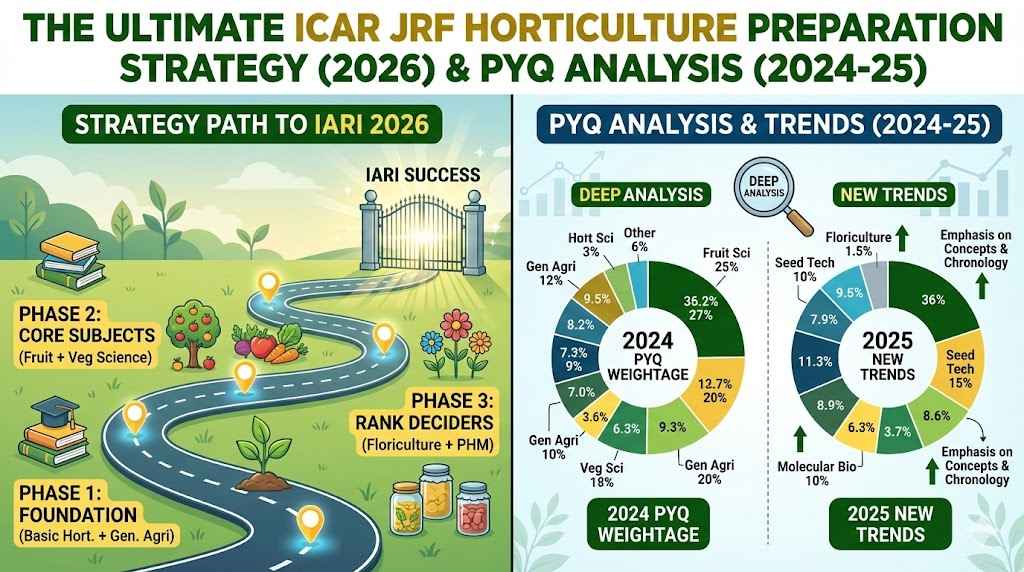
Many students were surprised by the 2025 paper. Why? Because the weightage shifted unexpectedly.
Here are the 3 Major Trends from the last two years:
The Rise of Floriculture: In 2025, questions from Landscaping, Gardens, and Loose Flowers increased significantly. It is no longer a minor subject.
Breeding & Biotech Focus: The examiner is asking deep questions on Micropropagation steps, Self-Incompatibility, and Male Sterility in vegetables and flowers.
General Agriculture Trap: Approx. 20-25% of the paper comes from General Agriculture (Genetics, Soil, Physiology). If you ignore Nemraj Sunda, you cannot clear the cutoff.
Step-by-Step ICAR JRF Horticulture Preparation Strategy & PYQ Analysis(The 3-Phase Plan)
To cover this vast syllabus without burning out, follow this phased approach.
Phase 1: The Foundation (Months 1-2)
Start with the basics. Don’t jump into varieties yet.
Focus: Fundamentals of Horticulture, Propagation methods, Planting Systems, and General Agriculture.
Resource: Basic Horticulture by Jitendra Singh + Nemraj Sunda.
Goal: Understand “How grafting works” and “Basics of Genetics/Soils”.
Phase 2: The Core (Months 3-4)
Cover the heavyweights—Fruits and Vegetables.
Fruit Science: Focus on Rootstocks, Propagation, and Climate requirements. (Resource: Ranjit Singh).
Vegetable Science: Master the Breeding Systems (CMS/SI) and Varieties of Solanaceous/Cucurbits. (Resource: D. Singh).
Phase 3: The “Rank Deciders” (Months 5-6)
This is where the topper is made.
Floriculture: Memorize Garden styles (Mughal vs Japanese) and Commercial Flowers. (Resource: Desh Raj).
Post-Harvest (PHM): Read about Canning, FPO standards, and Preservation. (Resource: R.P. Srivastava).
Mock Tests: Practice matching questions (Variety vs Parent).
Topic-Wise PYQ Analysis (2024 vs 2025)
Where should you focus? Based on my question-by-question count of the last two years, here is the breakdown:
| Subject / Unit | Approx. Questions (2025) | Importance Level |
| Fruit Science (Pomology) | 30 | 🚨 Very High |
| Vegetable Science | 28 | 🚨 Very High |
| Floriculture & Landscaping | 22 | 🔥 Rising Star |
| General Agri (Genetics/Soil) | 20 | 🔥 Rank Decider |
| Spices & Plantation | 12 | ⚖️ Moderate |
| Post-Harvest Mgmt (PHM) | 8 | 🏗️ Technical |
Insight: Notice that Floriculture + General Agri combined (42 Qs) is bigger than Fruit Science (30 Qs). Do not ignore them!
How to Tackle the “New” Question Types?
1. Handling “Sequence” Questions
The exam will ask you to arrange steps.
Example: Steps of Micropropagation (Explant $\rightarrow$ Shoot $\rightarrow$ Root).
Strategy: Make flowcharts for Tissue Culture and Breeding methods (Pure Line/Pedigree).
2. Cracking “Parentage” Questions
Strategy: You will get questions matching “Hybrid Variety” with “Parents”. Focus on key crops like Mango, Guava, Grape, and Tomato.
3. The “General Agri” Factor
Strategy: Questions on Schemes (PM Kisan launch date), Institutes (IIHR location), and basic Physiology (Nutrients) are common. Read Nemraj Sunda daily for 30 minutes.
Download Solved Papers & Master Analysis Report
Reading about the strategy is one thing, but seeing the data is another.
I have compiled an Exclusive PDF Report that contains:
Detailed Topic-wise breakdown of 2024 & 2025 papers.
List of “Must-Read” Topics (The Hidden Syllabus).
Trend Analysis tables to guide your daily schedule.
[Click Here to Download the Master Analysis Report PDF]
(This PDF is a goldmine for serious aspirants. Save it for your exam revision.)
Final Words
Horticulture is a beautiful subject, but it demands a balanced approach. Don’t be a “Pomology Expert” and a “Floriculture Zero.” Balance your preparation, and IARI is within your reach.
Your Next Step:
Download the Analysis Report above.
Check out our [Recommended Booklist Here] (Link to your booklist blog).
Start your Phase 1 preparation today!
All the Best, Future Scientists!
Download important Agri culture Book pdfs
Books name | PDF Download |
Arun Katyayan Volume 1 | |
Arun Katyayan Volume 2 | |
Principles of Agronomy by S. R. Reddy Book | |
Nemraj sunda books PDF in hindi |
Latest posts