ICAR JRF Agronomy 2 year paper analysis
A high ICAR JRF rank leading to admission at IARI, New Delhi, is the ultimate aspiration for every agriculture student. But the path is intimidating. Many students believe success depends solely on college prestige or inherent intelligence. Having guided aspirants and worked closely with farmers, I can tell you that success hinges on only one thing: the right blueprint.
The JRF examination is not about what you read, but how you read it. Let’s decode the recent ICAR papers to understand the examiner’s shifting mindset.
The Seismic Shift: Agronomy is Now Applied Science
The biggest mistake aspirants make is approaching Agronomy as a subject of simple field practices. The 2024 and 2025 papers prove that the exam has shifted decisively towards Applied Science and Conceptual Chemistry.
Examiner’s Mindset: From Rote Learning to Research Aptitude
The selection process has moved away from testing who can memorize the most facts to who can apply scientific principles. This explains the surge in assertion-reasoning, statement-based questions, and technical terminology.
| Parameter | Old Pattern (Pre-2024) | New Pattern (2024-2025) |
| Primary Focus | Crop Production & General Agriculture | Physiology & Soil Chemistry |
| Question Type | Direct, Single-Liner Facts | Conceptual, Assertion-Reason, Numericals |
| Success Factor | Memorization | Discipline & Analytical Skill |
Comparative Analysis: Subject Weightage Breakdown
Analyzing the raw number of questions reveals exactly where students need to invest their energy. The high weightage of Soil Science and the sudden surge in Physiology must guide your preparation.
| Subject Category | Approx. Qs (2024) | Approx. Qs (2025) | Key Insight |
| Plant Physiology & Biochemistry (Unit I) | 15 – 17 | 20 – 22 | Critical: The highest growth area. Now a non-negotiable top priority. |
| Soil Science & Nutrient Mgmt (Unit VI & VIII) | 26 – 28 | 20 – 22 | Foundation: Consistently dominates the paper. Focus on application. |
| Weed Management (Unit IV) | 18 – 20 | 16 – 18 | Technical: Requires mastering calculations and chemical groups. |
| Crop Production (Unit III) | 17 – 19 | 10 – 12 | Declining: Dedicate less time to generic cultivation details. |
| Water Management (Unit V) | 12 – 14 | 13 – 15 | Calculative: Must master formulas and instrument physics. |
| Agro-met, Tech & Remote Sensing (Unit II) | 15 – 17 | 11 – 13 | Awareness: Needs constant updating on satellites and schemes. |
Micro-Level Analysis: What They Really Asked
| Unit | Key Topics Covered | Type of Depth Tested (2024-2025) | Strategic Approach |
| Physiology (Unit I) | Photosynthesis, Respiration, Cell Biology, Genetics. | Molecular Level: ETS steps, Mitochondrial Proton Pumps, Gene Transcription Defects, Warburg Effect. | Concept Clarity: Go beyond surface definitions. Use diagrams and basic science sources. |
| Soil Science (VI & VIII) | Fertilizers, Problem Soils, Soil Chemistry. | Chemical & Regulatory: FCO Biuret limits, DAP/SSP manufacturing feedstocks, Soil enzyme activity (Dehydrogenase), USSL Salinity criteria. | Application: Focus on why reactions happen, not just what happens. |
| Weed Management (IV) | Herbicides, Control Methods, Ecology. | Analytical: Herbicide Dose Calculation (a.i.), Half-life and Persistence data, Matching Chemical Families (e.g., Isoxazolines). | Formula Mastery: Dedicated notebook for dosage calculations is essential. |
| Water Management (V) | Irrigation, Measurement, Soil Physics. | Engineering & Numericals: Duty/Delta formulas, Working principle of TDR/Pressure Plate/Neutron Probe, Irrigation system specifications (e.g., Furrow slope). | Physics Focus: Understand the science behind the instruments. |
| Crop Production (III) | Varieties, Classification, Minor Crops. | Specific Data: Classification of species (Cotton, Brassica), IARI/IIHR released varieties (Pusa Kiran, Arka Garima). | Highly Selective: Focus only on classification and research institute varieties. |
The “Out of Syllabus” Reality: Molecular Traps
The toughest questions in 2025 touched upon human genetics (Sickle Cell Anemia, Hemophilia) and molecular biology (Rieske Centre, specific genes). While technically linked to Unit I (Basic Sciences), these questions serve as high-level filters for IARI selection. They require disciplined, basic science reading beyond typical Agronomy literature.
The Strategic Roadmap to IARI
Your existing resources (Nem Raj Sunda, Arun Katyayan, and Reddy & Reddy) are sufficient. The challenge lies in allocating them correctly based on the new exam blueprint.
Resource Allocation Strategy
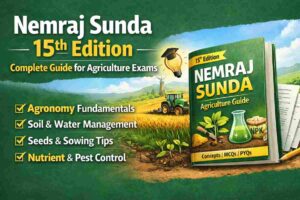
Nem Raj Sunda (The Foundation): This book must be the primary source for Unit I (Physiology) and factual parts of Unit VI (Soil Fertility). This is your foundation for tackling the hard conceptual questions.
Reddy & Reddy (The Core Agronomy): Use this exclusively for Unit II (Agromet), Unit IV (Weeds), and Unit V (Water). This provides the necessary depth in core Agronomy principles.
The Calculation Notebook: Maintain a separate file dedicated solely to practicing formulas for Herbicide Dose, Irrigation Duty/Delta, and Soil Moisture. Practice these daily.
Student POV: “I used to skip the basic science parts, thinking they were unnecessary. But after seeing these papers, I realize my foundation was the weak link. Spend time on the basics now.”
The Action Plan
Phase 1: Science First: Dedicate the first 30 days entirely to mastering Unit I (Physiology & Biochemistry), using Sunda. This breaks the biggest psychological barrier.
Phase 2: Conquer the King: Next, master Unit VI (Soil Science). Ensure you understand the chemical principles (like N-transformation and soil pH reactions).
Phase 3: Secure the Core: Follow with Unit IV (Weeds) and Unit V (Water), focusing heavily on numerical practice.
FAQs for Aspiring JRF Students
Yes. Calculations related to water management (Duty, Delta) and weed science (a.i. dose) are non-negotiable. They are objective, yielding full marks if the formula is correct, and act as significant rank boosters.
No. Focus on varieties released by premier research institutions like IARI (Pusa series) and IIHR (Arka series), as the papers primarily test those.
Absolutely. IARI selects candidates based on performance in the JRF exam, not based on your university CGPA. Your determination (zid) and following this strategic blueprint are the most powerful resources you have.
Buy Important jrf exam books
Book Title | Author/Publisher | Availability |
A Competitive Book of Agriculture | Nem Raj Sunda | |
Fundamentals of Agriculture (Vol. 1 & 2) | Arun Katyan | |
Objective Agriculture | S.R. Kantwa | |
Principles of Agronomy | T. Yellamanda Reddy & G.H. Sankara Reddi | |
Introductory Soil Science | D.K. Das | |
Plant Breeding: Principles and Methods | B.D. Singh | |
Textbook of Plant Pathology | P.D. Sharma | |
A Textbook of Entomology | H.S. Bhamrah | |
General Knowledge | Lucent's Publication | |
Animal husbandry | adda |
Related post