Are you still planning to crack JRF just by reading Reddy & Reddy? Stop right there!
Listen friends, if you are targeting ICAR JRF Agronomy 2026, you first need to accept a bitter truth: The old pattern is dead and gone.
I have deeply analyzed the question papers from 2024 and 2025. The examiner is no longer asking simple questions like “What is the scientific name of Wheat?”. They are now asking “What is the Mode of Action of this Herbicide?” and “How will you calculate the Fertiliser Dose?”
The JRF Agronomy exam is no longer just about ‘Rote Memorisation’; it is now a game of Concepts and Logic. If your dream is to get into IARI New Delhi (Pusa), your booklist must be of a “Topper Level” as well.
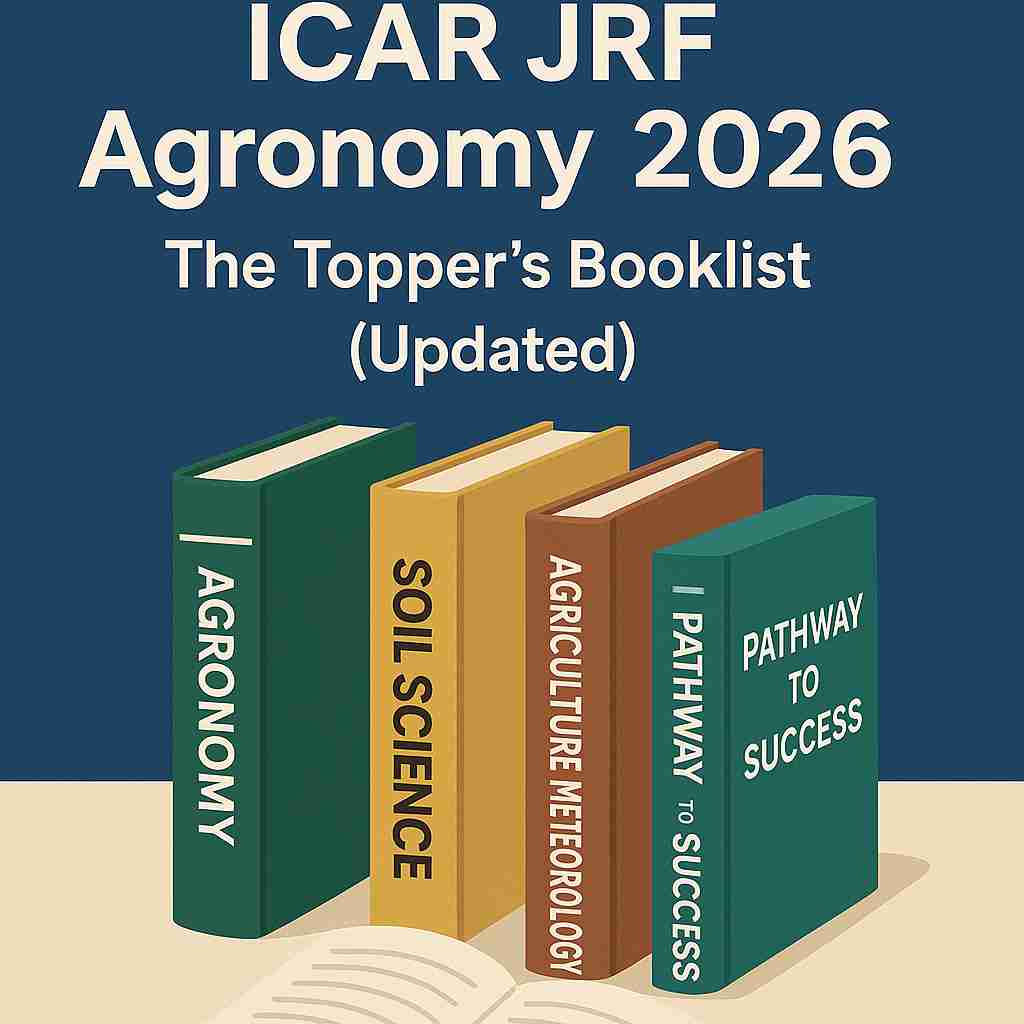
In this blog post, I will reveal the Complete Best Books for ICAR JRF Agronomy 2026 that rankers actually use but rarely share with others.
Why Do You Need the Best Books for ICAR JRF Agronomy 2026?
Previously, students could read just one or two basic books and get selected. But the 2025 paper has opened everyone’s eyes.
Assertion-Reason Questions: Now, 20-30% of questions are logic-based, requiring deep conceptual clarity.
Weed Science & Soil Science: These topics have become the “Rank Deciders”.
Numericals: Calculations regarding Herbicides, Fertilizers, and Water Management are now an integral part of the exam.
Therefore, you need Standard Books for every specific unit.
1. The “Bible” of Agronomy (Foundation Builders)
These are the books that will strengthen your basics. Without these, your JRF preparation cannot even begin.
Principles of Agronomy by T.Y. Reddy & G.H.S. Reddi
For Agronomy students, this book is nothing less than a “Holy Book” (Bible). It explains Tillage, Irrigation, Dryland Agriculture, and General Principles beautifully.
Why Read This: This book will build your “Base”. Maximum concepts from Unit-1 will be cleared right here.
Pro Tip: Make sure to memorize the tables given at the end of this book thoroughly.
👉 [Buy Principles of Agronomy on Amazon – Check Price] (Link Here)
Fundamentals of Agriculture (Vol 1 & 2) by Arun Katyayan

Whether it is Schemes, Extension, or General Agriculture—Arun Katyayan is the best. This book can fetch you full marks in the “General Agriculture” section of the paper.
👉 [Buy Arun Katyayan Vol 1 & 2 on Amazon] (Link Here)
2. The “Rank Deciders” (Advanced Books)
This is where the real competition is beaten. 90% of students ignore these books, which is exactly why they fail to reach IARI.
Weed Science by T.K. Das
The weightage of Weed Science increased significantly in the 2025 paper. Basic definitions are no longer enough. T.K. Das Sir’s book covers Herbicide Classification and Mode of Action in great detail.
Topper’s Advice: If you master this book, you will be miles ahead of the crowd.
👉 [Buy Weed Science by T.K. Das – Essential for JRF] (Link Here)
Introductory Soil Science by D.K. Das

You are giving an Agronomy paper, but Soil Science (Physics & Fertility) will not leave your side. This is the best book to understand Nutrient Deficiency and Fertilizers.
👉 [Buy Introductory Soil Science by D.K. Das] (Link Here)
3. Crop Production & Numericals (New Trend)
Agronomy of Field Crops by S.R. Reddy

This is the most reliable book for the production technology of Rabi and Kharif crops. The data regarding varieties, climate, and seed rates is authentic.
👉 [Buy Agronomy of Field Crops by S.R. Reddy] (Link Here)
Agri-Numericals by Nagarwa & Bhatnagar
Many students panicked seeing the Numericals in 2025. It is essential to practice calculations for Fertilizers, Herbicides, and Water Requirements using this book.
4. Best Objective Book for Practice
Reading concepts is not enough; practicing questions is crucial to avoid negative marking.
Objective Agronomy by S.R. Kantwa

This book is a “Panacea” (Ram-Baan) for JRF aspirants. It contains chapter-wise questions.
My Advice: Don’t just tick ‘A/B/C/D’. Instead, use this book to specifically practice Statement-Based Questions.
👉 [Buy Objective Agronomy by S.R. Kantwa] (Link Here)
How to Study These Books? (Topper’s Strategy)
Do not turn your room into a library; study smartly:
Syllabus is Key: Do not make the mistake of reading books cover-to-cover. Mark the topics according to your JRF syllabus.
Make Flowcharts: Create flowcharts to remember processes (like the Nitrogen Cycle or Herbicide Absorption).
Interlinking: When reading Soil Science, try to connect it with Crop Production (e.g., connecting nutrient requirements to specific crops).