
Table of Contents
If you are a BSc Agriculture student, there is one subject that gives everyone sleepless nights—Plant Pathology. The syllabus is vast, the scientific names are confusing, and disease cycles? Don’t even get me started.
But here is the truth: Pathology is actually one of the most scoring subjects agar aapke pass sahi study material ho.
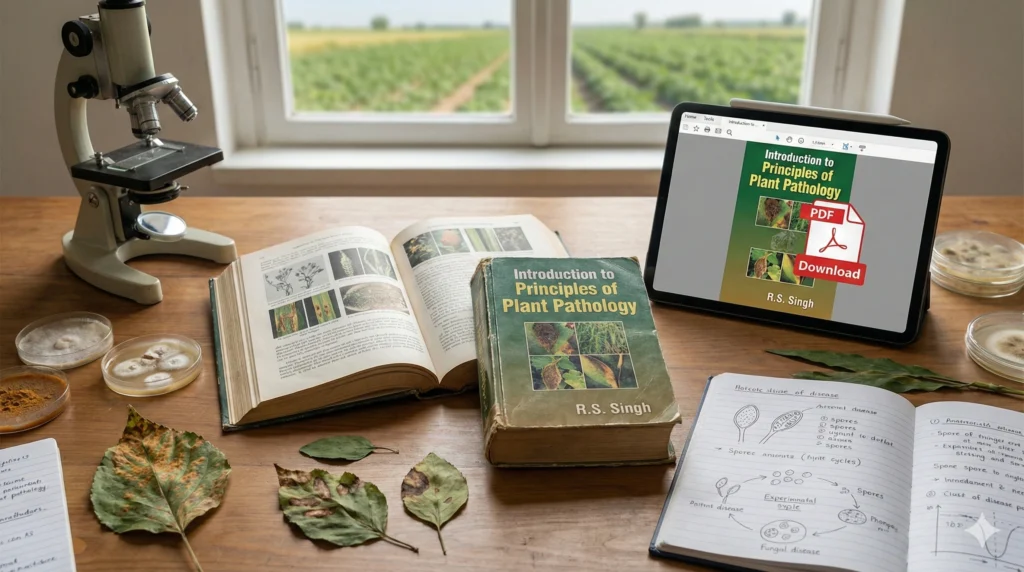
When it comes to standard textbooks in India, nothing beats “Plant Diseases” by R.S. Singh. Whether you are preparing for your semester exams, ICAR JRF (Plant Science), or just want to understand how a fungus destroys a crop, this book is the gold standard.
Today, I am sharing the R.S. Singh Plant Diseases Book PDF and, more importantly, how to read it effectively so you don’t waste time.
Why R.S. Singh is a Must-Have for Agriculture Students?
You might be thinking, “Sir, market me toh bohot saari books hain, why this one?”
Trust me, as someone who has been through the grind of semester exams and competitive preparations, I can tell you that generic coaching notes won’t help you build clear concepts. R.S. Singh separates itself because:
Language is Student-Friendly: Even though it’s a standard text, the language isn’t overly complicated. It explains complex mechanisms (like host-pathogen interaction) in a flow that just makes sense.
Systematic Classification: The book divides diseases based on crops and pathogens (Fungal, Bacterial, Viral), which is exactly how our 5th Dean Committee syllabus is structured.
Detailed Disease Cycles: Diagrams are everything in Pathology. This book provides clear life cycles (aetiology) that you can directly practice for your practical exams.
Pro Tip: If you are targeting ICAR JRF/SRF, this book covers about 80% of the static questions related to disease management and causal organisms.
What Does This Book Cover? (Syllabus Overview)
Before you hit the download button, let’s see what exactly you are getting. This isn’t just a random PDF; it’s a complete package for your degree.
Introduction to Plant Pathology: History, scope, and general principles.
Diseases of Field Crops: Detailed study of Rusts, Smuts, Wilts, and Blights in Wheat, Rice, Maize, etc.
Horticultural Diseases: Major issues in Mango, Citrus, Potato, and Tomato.
Pathogen Biology: Understanding Fungi, Bacteria, Viruses, Viroids, and Phytoplasmas.
Plant Disease Management: Cultural, biological, and chemical control methods (IDM).
Bas itna samajh lo, if you master the “Diseases of Field Crops” section from this book, your 4th and 5th-semester GPAs are sorted.
How to Study Plant Pathology Effectively?
Providing the PDF is easy, but as a senior, I want to make sure you actually use it. Downloading a book and keeping it in a folder named “Study Material” won’t get you marks.
Here is a strategy that works:
Don’t Read it Novel-Style: Never read pathology like a storybook. Pick one crop (e.g., Rice) and study all its diseases (Blast, BLB, Tungro) together.
Make Comparison Tables: Create a table with columns: Disease Name | Causal Organism | Symptoms | Management. This is the best way to remember scientific names.
Focus on “Keywords”: Examiners look for specific terms like “Pycnidia,” “Haustoria,” or “Zoospores.” R.S. Singh highlights these technical terms beautifully.
Download R.S. Singh Plant Diseases Book PDF
Okay, the wait is over. Below is the link to access the material. I suggest keeping a digital copy on your phone for quick revision during field visits or practicals, but if possible, try to buy the hard copy later for your library—books are an investment.
[ Click Here to Download PDF] (399mb)(Cover 1 to 10 unit) (Link Note: Please ensure you use this for educational purposes only.)
Frequently Asked Questions (FAQs)
It is excellent for the “Plant Pathology” section. However, for General Agriculture and Microbiology, you will need to refer to other sources like Nem Raj Sunda or specific microbiology texts. But for pathology core concepts? Yes, it is enough.
Yes! While 1st year mostly covers “Introductory Plant Pathology,” this book explains the basics (History, Koch’s Postulates) very clearly. Kaafi helpful rahega base strong karne ke liye.
R.S. Singh primarily focuses on Fungi, Bacteria, and Viruses. For Nematology, you might need to check “Introductory Nematology” by different authors, though this book touches on basic symptoms caused by nematodes.
Latest posts
How to Choose the Best Topic for Agriculture Popular Article?
Every great publication starts with a single, powerful idea. However,...
Read More
JNKVV & RVSKVV Joint PG Entrance Exam Previous Year Question Papers (PDF)
Whatsapp Are you gearing up for the upcoming JNKVV and...
Read More
Complete Agronomy Course Free – Notes, PPT & YouTube Lectures (Syllabus Wise for All Agriculture Exams)
Course Purchase karne ki jarurat nhi hai. Syllabus wahi hai,...
Read More
👉Top 100 Crop Improvement in Rabi Crops MCQs + Fill in Blanks + One Liners (Exam Special)
Crop improvement in rabi crops MCQs is one of the...
Read More⚠️ Important Disclaimer & Copyright Notice:
This PDF is provided strictly for educational and informational purposes only. We do not own the copyrights to this book/material. It has been collected from various open sources available on the internet to assist students who may be financially weak or unable to access the hard copy for their studies.
We strongly encourage students to buy the original hard copy from the publisher to support the authors for their hard work.