Table of Contents
Do you dream of walking into the lush green campus of IARI New Delhi?
Every agriculture graduate shares this dream. But let’s be honest—cracking ICAR JRF Agronomy is no longer a walk in the park. Gone are the days when you could memorize 500 varieties of crops and secure a top rank.
I have analyzed the 2024 and 2025 question papers question-by-question. The verdict is clear: The exam has shifted from “Information-based” to “Concept-based”.
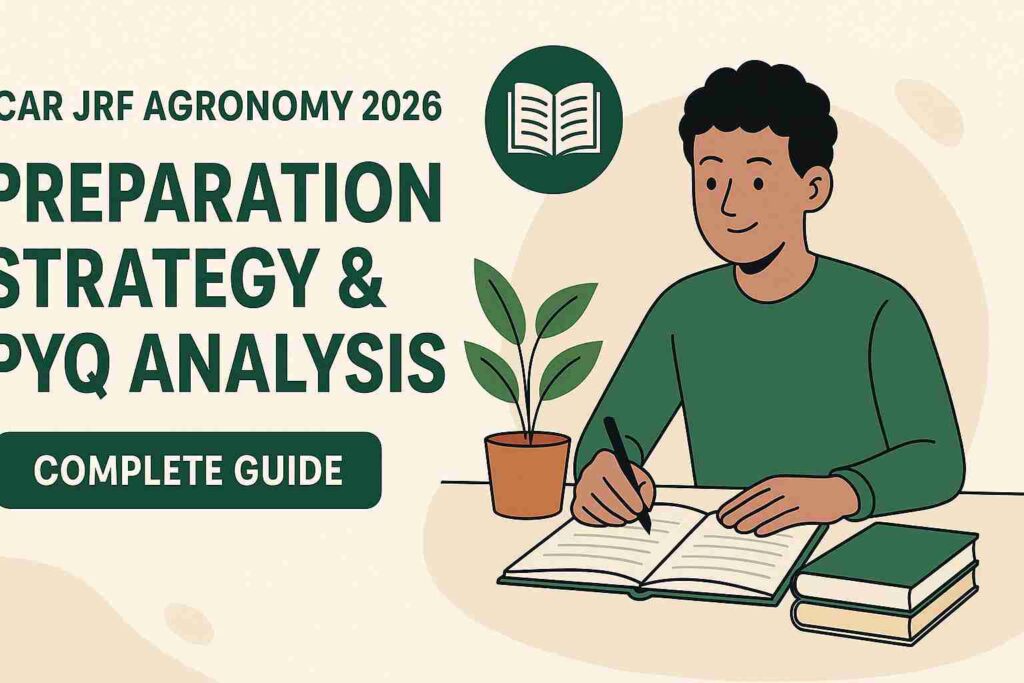
If you are preparing for the 2026 session, your strategy needs an upgrade. In this ICAR JRF Agronomy Preparation Strategy 2026 & PYQ Analysis guide, I will decode the new exam pattern, share a proven roadmap, and provide a deep analysis of the last two years’ papers.
The “New Pattern” Decoded: What Changed in 2024-25?
Many students studied hard but failed to get a good rank in 2025. Why? Because they were fighting a modern war with old weapons.
Here is what the 2024 and 2025 Papers taught us:
Rise of “Assertion-Reason”: Approx. 20-25% of the paper now consists of Statement/Reason questions. These test your logic, not your memory.
Numericals are Here: Students used to skip calculations. In 2025, questions on Herbicide Doses, Fertilizer Calculations, and Irrigation Water were rank deciders.
Weed & Soil Science Dominance: The weightage of these two subjects has skyrocketed. If you only read Crop Production, you are at risk.
Step-by-Step Preparation Roadmap (The 3-Phase Plan)
To clear JRF Agronomy with a single-digit rank, divide your preparation into three phases.
Phase 1: Building the Foundation (Months 1-2)
Don’t jump into complex books yet. First, clear your basics.
Focus: General Agriculture, Tillage, Irrigation, and Dryland Agriculture.
Resource: Principles of Agronomy by Reddy & Reddy.
Goal: You should be able to answer “Why do we do this?” for every agricultural practice.
Phase 2: The “Rank Decider” Phase (Months 3-4)
This is where you beat the crowd. Most students skip deep reading of Weed and Soil Science.
Weed Science: Master the Classification of Herbicides and their Mode of Action. (Resource: T.K. Das).
Soil Science: Focus on Soil Fertility, Nutrient Deficiency symptoms, and Manures. (Resource: D.K. Das).
Phase 3: Application & Numericals (Months 5-6)
Numericals: Practice at least 10 calculation questions daily (Fertilizer/Weed/Water).
Crop Production: Memorize varieties, seed rates, and critical stages for major field crops.
Mock Tests: Start solving papers that have “Assertion-Reason” questions to build your logic.
Topic-Wise PYQ Analysis (2024 vs 2025)
Where should you focus your energy? Based on my analysis of the last two papers, here is the reality check:
| Subject / Unit | Approx. Questions (2025) | Importance Level |
| Soil Science & Nutrient Mgmt | 20-22 | 🚨 Very High |
| Plant Physiology & Biochemistry | 20-22 | 🚨 Very High |
| Weed Management | 16-18 | 🔥 High |
| General Agri & Schemes | 15-17 | ⚖️ Moderate |
| Water Management | 13-15 | ⚖️ Moderate |
| Crop Production | 10-12 | 📉 Decreasing |
Insight: Do you see the drop in “Crop Production”? The examiner is focusing more on Science (Physiology/Soil) than Production.
How to Tackle the “New” Question Types?
1. Handling Numerical Problems
Don’t fear the math. The questions are usually formula-based.
Must-Know Formulas:
Herbicide Dose (a.i.) calculation.
Fertilizer Requirement based on NPK dose.
Water Discharge rate.
Tip: Keep a separate notebook for formulas and revise it every Sunday.
2. Cracking Statement Based Questions
Read Carefully: Often, Statement I is correct, but Statement II contradicts it.
Concept Linking: These questions test if you can link two concepts (e.g., “Nitrogen deficiency causes yellowing” AND “Nitrogen is part of Chlorophyll”).
Download Solved Papers & Master Analysis Report
Reading about the strategy is one thing, but seeing the actual questions is another.
I have compiled a Exclusive PDF Report that contains:
Topic-wise breakdown of 2024 & 2025 papers.
Detailed Analysis of the hardest questions.
The “Hidden Syllabus” topics you must not miss.
[Click Here to Download the Master Analysis Report PDF]
(This PDF is free for serious aspirants. Save it on your phone for daily reference.)
Get best booklist for ICAR JRF Agronomy
Download important Agri Book pdfs
Books name | PDF Download |
Arun Katyayan Volume 1 | |
Arun Katyayan Volume 2 | |
Principles of Agronomy by S. R. Reddy Book | |
Nemraj sunda books PDF in hindi |
Latest post